Blog
Decoding the Brain: Insights from the Neural Frontier
Welcome to my digital laboratory notebook where science meets storytelling. Join me as I explore the fascinating intersections of neuroscience, data analysis, and technology. Whether you’re a fellow researcher, a curious student, or simply intrigued by how our brains process the world around us, you’ll find something to spark your interest here.
My Writing Spaces
Personal Reflections
Explore my articles on Medium where I share insights on neuroscience, data analysis techniques, and occasional musings on technology and science.
Note: I’m in the process of updating my Medium profile. Check back soon for new content!
Technical Contributions
Follow my contributions to the Blech_Clust neural data extraction and analysis pipeline, where I document improvements and new features.
Latest Update: “Implementing Parallel Processing for Faster Spike Sorting”
Current Research Spotlight
I’m currently investigating how feedback projections from the gustatory cortex influence taste processing in subcortical regions. This research challenges traditional views of sensory processing as a purely feedforward mechanism and suggests a more dynamic, recurrent network.
Research Question:
How do cortical feedback projections modulate the temporal dynamics of taste processing in the amygdala and thalamus?
Tutorial Series: Probabilistic Modelling
An open-access series of lecture slides and Jupyter notebooks for learning probabilistic modelling techniques. Designed for graduate students and researchers in quantitative fields.
Topics covered:
- Probabilistic Programming in PyMC3 — Fitting distributions, Bayesian linear regression, and changepoint modelling (Poisson, Bernoulli, Gaussian), including an advanced multi-changepoint model with mixture emissions for repeated timeseries
- Gaussian Mixture Models and Hidden Markov Models — Unsupervised clustering exercises and HMM fundamentals
- Bayesian Changepoint Modelling — Extended treatment from a PyMCon talk
View Tutorial Series on GitHub · PyMCon Changepoint Talk
Handwritten Analytical Derivations
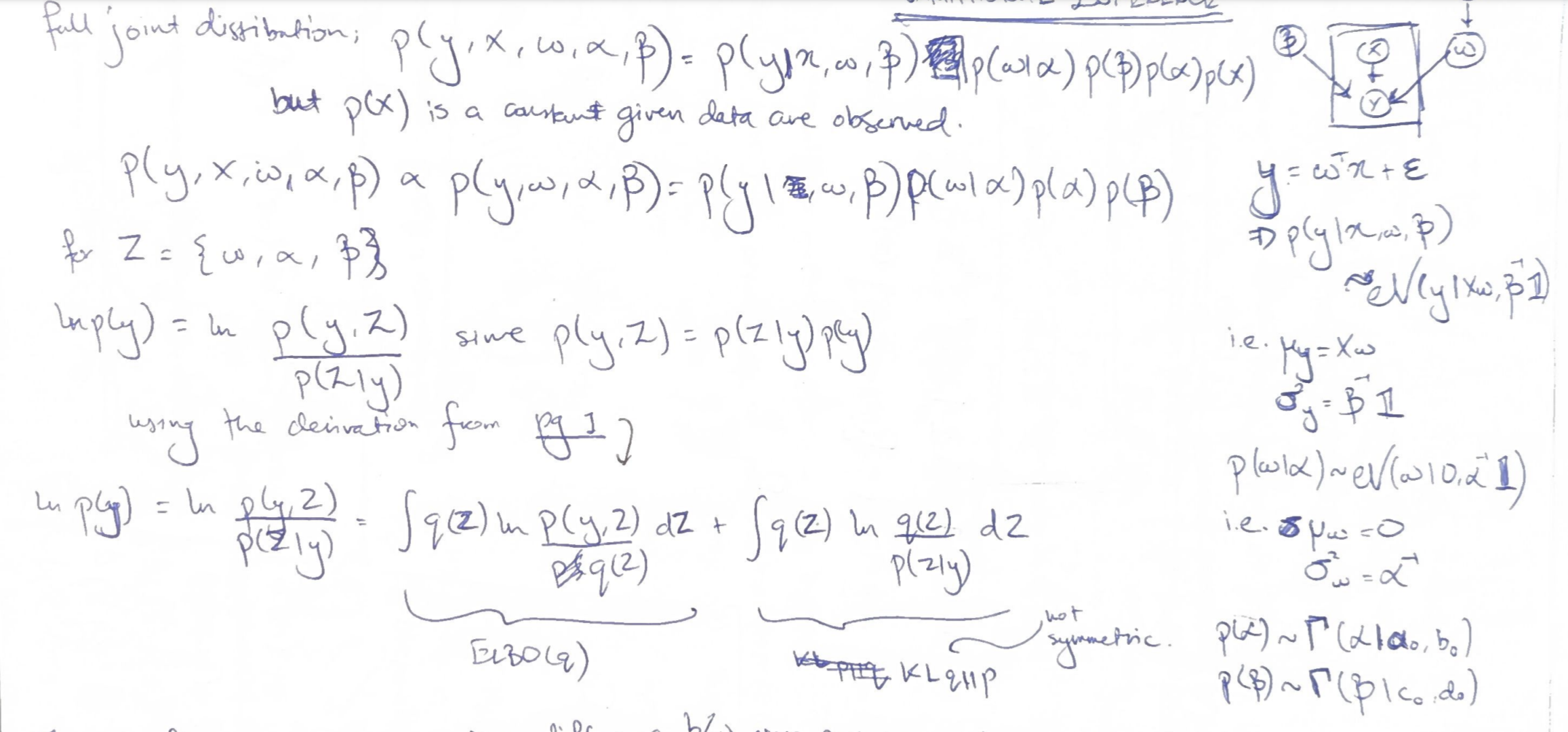
Textbooks often assume too much about how intuitive each step in a derivation is for the reader. These handwritten derivations provide an exhaustive, step-by-step breakdown that is (hopefully) easy to follow, with no steps omitted.
- Gaussian MLE (1D) — Maximum likelihood estimates for the mean and variance of a 1D Gaussian, with every calculus step shown.
- Linear Regression MLE — Ordinary least squares via MLE, including the matrix calculus leading to the normal equations.
- GMM Expectation-Maximization — Full EM algorithm for Gaussian Mixture Models: E-step responsibilities and M-step parameter updates with all intermediate algebra.
- Bayesian Linear Regression - Variational Inference — Derivation of variational inference for Bayesian linear regression, including the evidence lower bound (ELBO), posterior updates for weights and noise precision, and the predictive distribution.
- Single Poisson Changepoint MLE — Handwritten derivation of maximum likelihood estimation for a single changepoint Poisson model, including the analytical gradients and gradient descent update rules. Includes accompanying Jupyter notebook with implementation, Laplace approximation of the posterior, and visualization of samples from the Laplace posterior.
- Multi Poisson Changepoint MLE — Handwritten derivation extending the Poisson changepoint maximum likelihood framework to multiple changepoints. Includes accompanying Jupyter notebook with implementation code for the multi-changepoint model.
- Laplace Approximation — Derivation of the Laplace approximation, showing how the negative Hessian of the log-posterior evaluated at the MAP estimate yields the covariance matrix of a Gaussian approximation to the parameter posterior.
- Rescorla-Wagner Model — Derivation of the Rescorla-Wagner model, a classical reinforcement learning model that describes how animals learn from prediction errors. Includes the learning rule derivation and connection to logistic regression via the cross-entropy loss.
Analytical Derivation Roadmap
Future derivations will expand the changepoint modelling notes across three directions:
- Logical extensions — Multi-trial emissions, multivariate Poisson emissions, combined multi-trial/multivariate changepoints, Dirichlet-distributed changepoints, and Dirichlet process changepoints.
- Pragmatic extensions — Negative Binomial emissions for overdispersed counts, autoregressive rate histories, covariate-modulated transitions, and state-specific transition smoothness.
- Advanced frameworks and approximations — Discrete HMMs, EM/Baum-Welch updates, mean-field variational inference, and Polya-Gamma data augmentation.
View the full Analytical Derivation Roadmap
Upcoming Content
Stay tuned for these topics:
- The Taste Circuit: A Neural Symphony: How does your brain know the difference between sweet and sour? Dive into my latest research on how multiple brain regions coordinate to create your taste experience.
- Neural Dynamics Visualized: Interactive visualizations of taste-responsive neural populations
- Machine Learning in Neuroscience: A practical guide to implementing deep learning models for neural data analysis
- The Attractor Network Hypothesis: Evidence for and against attractor dynamics in sensory processing
Join the Conversation
Science thrives on collaboration and discussion. Have questions about my research? Interested in collaborating? Or simply want to share your thoughts on these topics?
Subscribe to Updates: Join my newsletter to receive notifications when new content is published.